
How to Choose the Right Airless Bottle Size for Your Skincare Product
Choosing an airless bottle involves more than selecting an attractive shape or finish. The capacity must also match the formula, how frequently it will be applied and how the finished product will be positioned.
A bottle that is too small may not provide enough product for its intended use, while an unnecessarily large package can affect pricing, portability and the customer experience.
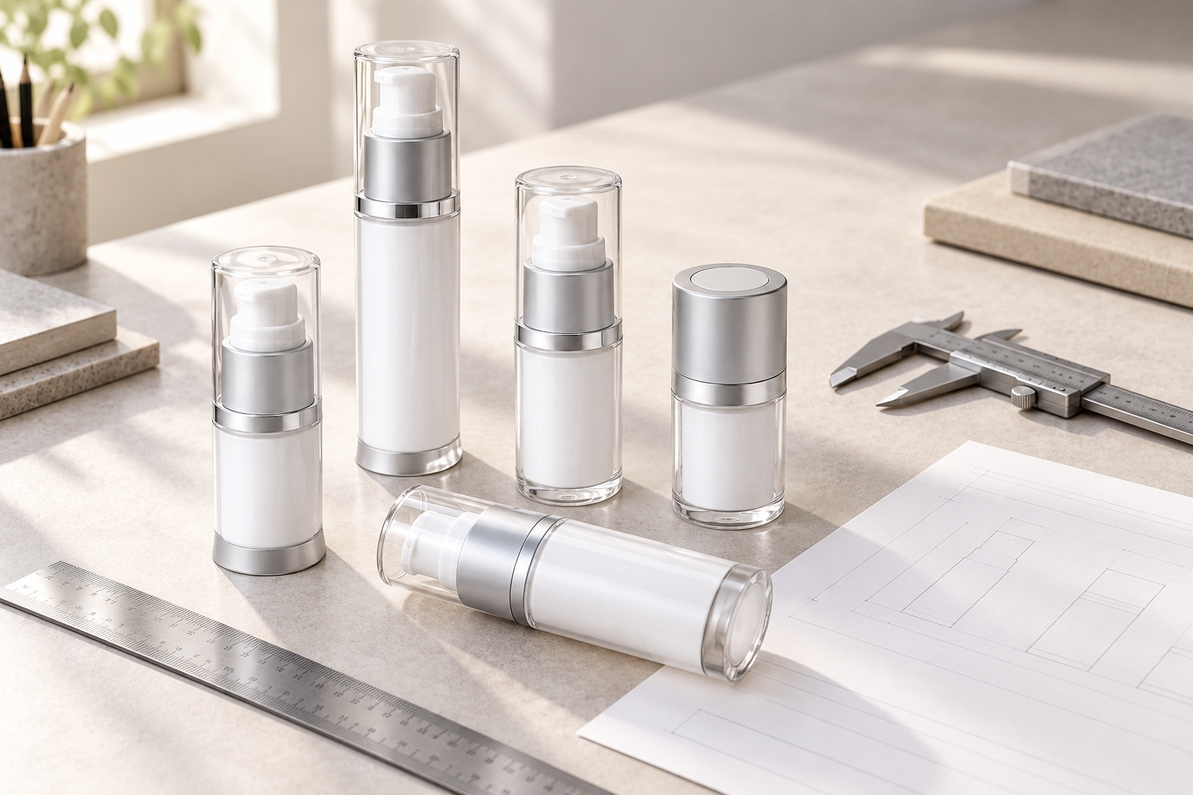
Common airless bottle capacities include 5 ml, 15 ml, 30 ml, 50 ml and 130 ml. Each size can serve a different role, from samples and concentrated treatments to daily moisturizers and body-care products.
Start With the Product’s Intended Use
The right capacity depends partly on where the product will be applied and how much is expected to be used during each application. An eye treatment typically requires much less product than a body lotion. A concentrated facial serum may be dispensed in small amounts, while a moisturizer may be applied more generously.
Before comparing bottle sizes, consider:
• The amount of product used per application
• How many times per day or week the product will be used
• The desired length of use for one bottle
• Whether the package is intended for sampling, travel, retail sale or professional use
• The formula’s viscosity and compatibility with the pump system
These details provide a more useful starting point than selecting a capacity based on appearance alone.
5 ml Airless Bottles: Samples and Trial Sizes
A 5 ml airless bottle is a compact option for products that are used sparingly or offered in small quantities. It can be considered for skincare samples, discovery kits, travel sets, subscription boxes and promotional introductions.
This size may also work for highly concentrated formulas when only a small amount is required per application. However, the available fill may be too limited for a full-size daily moisturizer or another product that consumers use generously.
Potential applications: Facial-serum samples, eye-treatment samples, primers, concentrated treatments and product-testing programs.
15 ml Airless Bottles: Eye Care and Concentrated Treatments
A 15 ml airless bottle, approximately 0.5 oz, offers more capacity than a sample container while remaining compact. It is commonly considered for eye creams, targeted treatments, concentrated serums and travel-size skincare.
The smaller format can support a premium presentation, especially when paired with acrylic construction, metallic accents or a twist-up dispensing design. It may also be useful when a brand wants to offer a lower-priced trial size.
Potential applications: Eye creams, eye serums, spot treatments, facial serums, primers and travel-size products.
30 ml Airless Bottles: A Versatile Facial-Skincare Size
A 30 ml airless bottle, approximately 1 oz, is a familiar capacity for facial skincare. It provides enough room for many full-size serums, facial lotions, primers and treatment products without creating an oversized package.
This capacity is especially versatile because it can accommodate a wide range of product positions, from streamlined everyday skincare to more luxurious formulations. Available designs may include white, frosted, silver-accented and twist-up bottles.
Potential applications: Facial serums, daily treatments, primers, liquid foundations, lightweight moisturizers and facial lotions.
50 ml Airless Bottles: Moisturizers and Daily-Use Formulas
A 50 ml airless bottle provides additional capacity for products used in larger amounts. It can be considered for daily facial moisturizers, richer lotions, creams and treatment products intended for use over a longer period.
The increased capacity can offer a substantial retail presentation while remaining practical for a bathroom counter, vanity or skincare kit.
When comparing 30 ml and 50 ml packaging, consider whether the formula is applied only to the face or also to the neck and décolletage, since the expected usage amount may differ.
Potential applications: Facial moisturizers, neck treatments, creams, lotions, primers and larger-format serums.
130 ml Airless Bottles: Larger-Capacity Skincare and Body Care
A 130 ml airless bottle can suit formulas used more generously or across a larger application area. It may be considered for hand lotions, body treatments, larger skincare products and professional-size formulas.
This size creates a more substantial package and may be less suitable for travel or concentrated treatments. Brands should also consider the finished product’s weight, retail price and expected period of use before selecting a larger capacity.
Potential applications: Hand lotions, body lotions, body treatments and larger-format professional products.
Quick Airless Bottle Size Comparison
• 5 ml: Samples, discovery sets and concentrated treatments
• 15 ml: Eye products, targeted treatments and travel skincare
• 30 ml: Facial serums, primers, treatments and lightweight lotions
• 50 ml: Moisturizers, creams and larger daily-use formulas
• 130 ml: Hand, body and professional-size products
Estimate How Long the Product Should Last
Capacity should be evaluated alongside expected product usage.
Begin with the approximate amount dispensed by each pump. Multiply that amount by the expected number of pumps used during each application and then consider how frequently the product will be applied.
Pump output can vary between bottles, so calculations should be based on testing the actual packaging instead of assuming that every pump dispenses the same amount.
A package that lasts for too short a period may disappoint customers. A package that lasts much longer than intended may not align with the formula’s recommended period of use after opening.
Testing can help determine whether the selected bottle size and pump output create an appropriate customer experience.
Consider More Than Capacity
Two airless bottles with the same capacity can offer different shapes, materials, dispensing styles and decoration areas.
After identifying the likely fill size, compare:
• Bottle dimensions and shelf presence
• Round, square or twist-up designs
• White, frosted, clear or metallic finishes
• Available space for labels or other decoration
• Pump output and dispensing experience
• Protection for the pump during storage and transportation
• Component and formulation compatibility
The bottle should be evaluated as a complete package. Capacity, dispensing performance and presentation all contribute to the finished product.
Test the Selected Bottle Before Production
Size alone does not determine whether an airless bottle will work with a formula. Viscosity, ingredients, filling methods and the presence of air pockets can all affect dispensing.
Airless bottles generally need to be filled correctly so the internal platform can rise and move the product toward the pump.
Perform compatibility and fitness testing using the finished formulation and selected bottle. Test several filled units over an appropriate period and evaluate dispensing, leakage, component interaction and the customer-use experience before committing to production quantities.
Explore Airless Bottles by Size
Beauty-Makeup-Supply offers airless pump bottles in capacities ranging from compact 5 ml samples to larger 130 ml packaging.
Multiple styles are available for professional skincare and cosmetic packaging, with no minimum purchase requirement, wholesale pricing and in-stock inventory ready for shipment. Free U.S. ground shipping is available.
Compare the available capacities and designs, order a single unit for samples when needed and test the selected package with the finished formula to determine the best option for the product.
Recent Posts
-
How to Choose the Right Airless Bottle Size for Your Skincare Product
Choosing an airless bottle involves more than selecting an attractive shape or finish. The capacity …16th Oct 2026 -
What Is an Airless Pump Bottle and How Does It Work?
Airless pump bottles have become a popular packaging choice for serums, lotions, moisturizers and ot …3rd Aug 2026 -
Top Cosmetic Packaging Trends for 2026
Introduction Cosmetic packaging continues to evolve as skincare brands adapt to changing consumer ex …21st May 2026