
What Is an Airless Pump Bottle and How Does It Work?
Airless pump bottles have become a popular packaging choice for serums, lotions, moisturizers and other skincare formulations. Their dispensing system is designed to limit a formula's exposure to outside air during normal use while helping consumers dispense the product in controlled amounts.
Unlike a traditional pump bottle that commonly uses a dip tube, an airless bottle generally relies on a platform or piston inside the container. Each time the pump is pressed, the platform gradually moves upward and pushes the formula toward the dispensing opening.
Understanding how this system works can help beauty brands, skincare professionals and product developers determine whether airless packaging is appropriate for a particular formulation.
How Does an Airless Pump Bottle Work?
An airless bottle typically includes a bottle body, pump mechanism and internal platform. Rather than drawing the formula through a long tube, the pump creates pressure that allows the platform at the bottom of the bottle to rise.
As the platform moves upward, it pushes the product toward the pump. This design can reduce the amount of product left behind at the bottom of the package and lets the bottle dispense from different positions once it has been filled and properly primed.
The word “airless” does not mean that the package is filled in a completely oxygen-free environment. It refers to the mechanical dispensing system and the way it limits the repeated entry of outside air during use.
Benefits of Airless Cosmetic Packaging
Reduced Exposure During Dispensing
Because the package does not require consumers to repeatedly open a jar or insert their fingers into the product, an airless bottle can help limit routine contact with outside air and hands.
Controlled Product Dispensing
The pump dispenses a measured amount with each press. This can make the product easier to use and help reduce accidental over-dispensing.
Less Product Left in the Container
The rising platform pushes the formula toward the pump instead of leaving it around a dip tube at the bottom of the bottle. Actual evacuation performance depends on the formulation, bottle design and filling process.
Professional Presentation
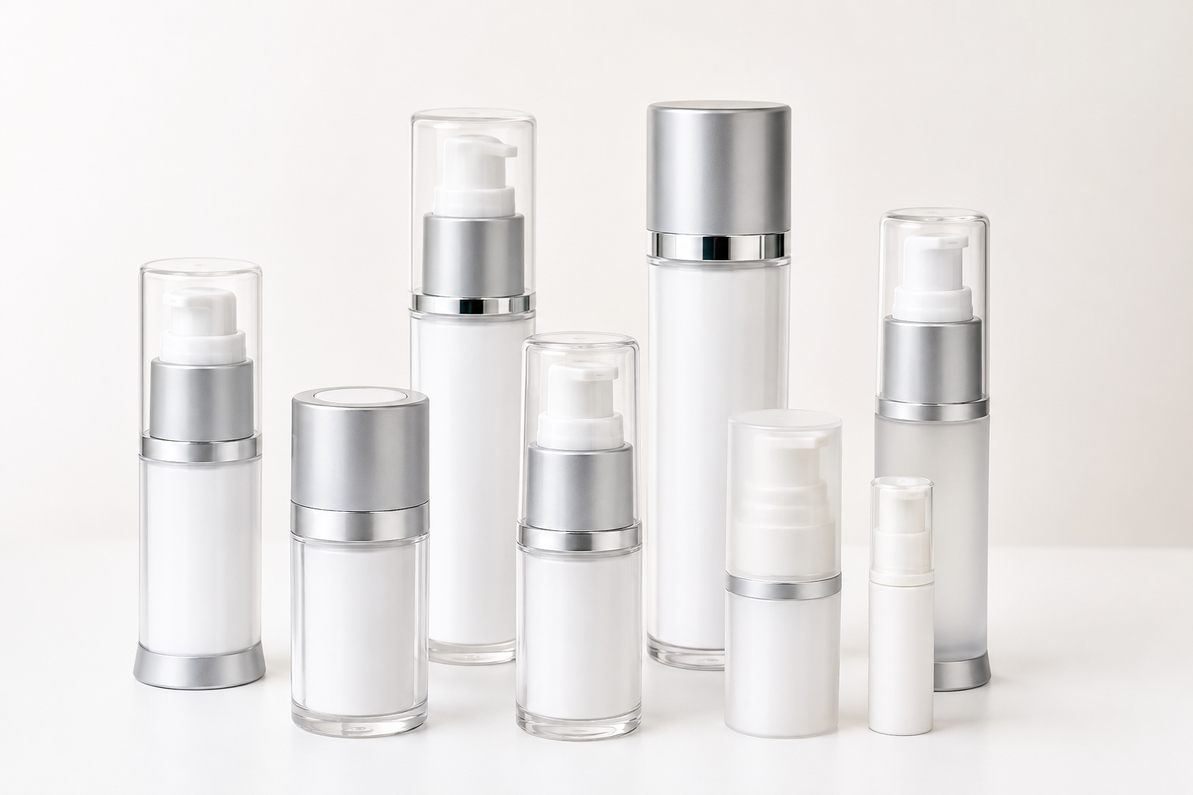
Airless bottles are available in white, clear, frosted, silver-accented, acrylic and twist-up styles. This variety gives beauty brands options for both streamlined and luxury skincare packaging.
Multiple Capacity Options
Small 5 ml bottles can be considered for samples, travel products and subscription boxes. The 15 ml size is commonly considered for eye treatments and concentrated serums, while 30 ml bottles are a familiar option for facial products. Larger 50 ml and 130 ml bottles may be suitable for moisturizers, lotions and other products used in greater amounts.
What Products Can Be Packaged in Airless Bottles?
Depending on formulation viscosity and compatibility, airless bottles may be considered for:
• Facial serums
• Eye treatments
• Moisturizers
• Facial lotions
• Creams
• Primers
• Liquid foundations
• Treatment products
• Hand and body products
Airless packaging is not automatically suitable for every formula. Products that are extremely thick, contain large particles or are otherwise difficult to pump may not dispense properly. The formula, pump output and package components must work together.
Always perform compatibility and fitness testing with the finished formulation before production.
Airless Bottles vs. Traditional Pump Bottles
Traditional pump bottles frequently use a dip tube that pulls the product from the bottom of the container. An airless system generally uses a rising platform instead.
The best option depends on the product. A traditional pump may be appropriate for many liquids and lotions, while an airless bottle may be preferred when controlled dispensing, reduced routine exposure and a more specialized skincare presentation are priorities.
Packaging should be selected based on formulation performance rather than appearance alone.
Important Airless Bottle Filling Tips
Proper filling is essential to the operation of an airless bottle. Large air pockets can interrupt the vacuum action and prevent the platform from rising correctly.
For best results:
1. Fill the bottle evenly and as completely as the package specifications allow.
2. Avoid creating air pockets within the formulation.
3. Make sure the pump and other components are correctly assembled.
4. Prime the bottle by pressing the pump several times after filling.
5. Test multiple filled units before beginning full production.
If a newly filled bottle does not immediately dispense, it may simply need additional pumps to draw the product into the mechanism. Persistent dispensing problems can indicate trapped air, incomplete filling or a formulation that is not appropriate for that particular pump.
Choosing the Right Airless Pump Bottle
Consider the following when comparing airless packaging:
• Product type and viscosity
• Desired fill capacity
• Pump output
• Bottle dimensions
• Material and component compatibility
• Available label or decoration area
• Intended customer use
• Brand presentation
A sample or eye treatment may call for a compact 5 ml or 15 ml bottle, while a daily facial serum may be better suited to a 30 ml package. Moisturizers and body products may require a 50 ml or 130 ml capacity.
Beauty-Makeup-Supply offers airless pump bottles in multiple capacities and styles, including economical sample containers, classic refillable bottles, frosted designs, acrylic bottles and twist-up pump packaging. Wholesale pricing is available in the cart, with no minimum purchase requirement.
Review the available sizes and styles to identify potential packaging options, then test the selected bottle with the finished formulation before production.
Recent Posts
-
What Is an Airless Pump Bottle and How Does It Work?
Airless pump bottles have become a popular packaging choice for serums, lotions, moisturizers and ot …3rd Aug 2026 -
Top Cosmetic Packaging Trends for 2026
Introduction Cosmetic packaging continues to evolve as skincare brands adapt to changing consumer ex …21st May 2026 -
Why Cosmetic Packaging Matters for Small Skincare Brands
Introduction For small skincare brands, cosmetic packaging serves a purpose far beyond simply contai …6th May 2026