
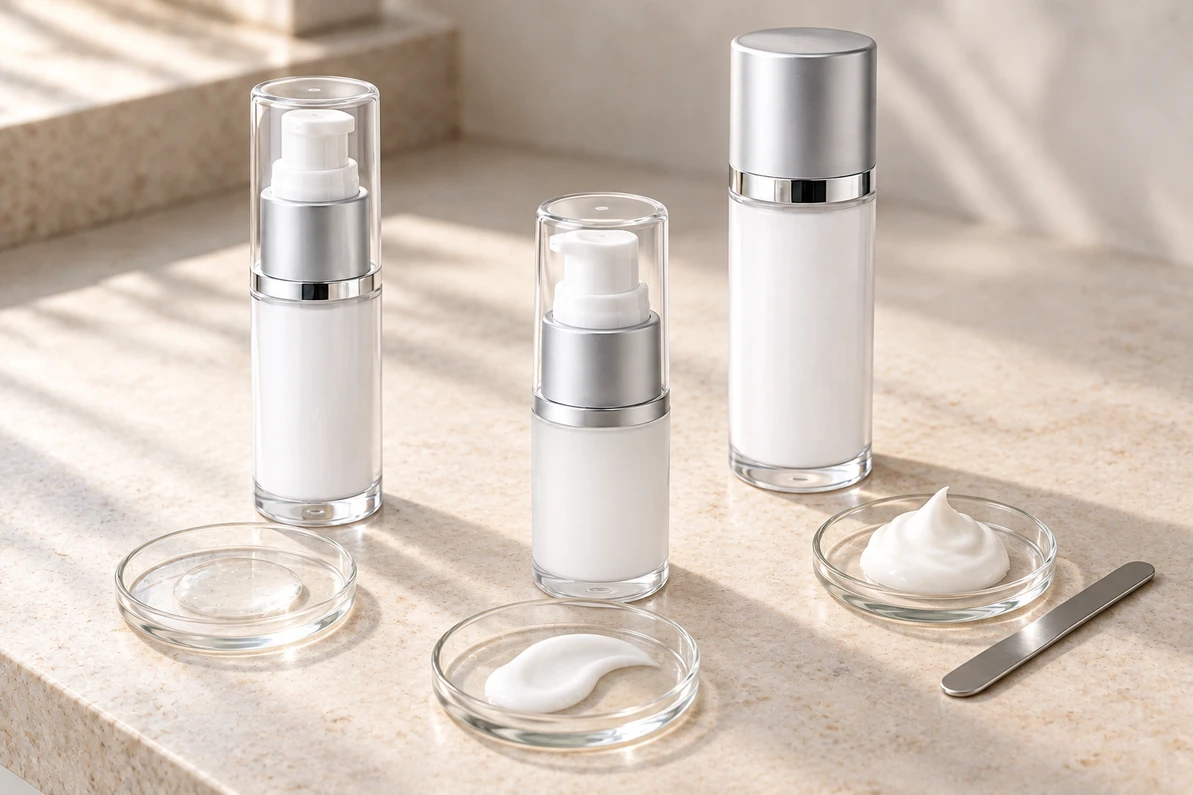
How to Choose an Airless Bottle for Serums, Lotions and Creams
Airless bottles are used for many skincare and cosmetic products, but one bottle will not necessarily work equally well with every formulation.
A lightweight serum, daily facial lotion and rich cream can have very different dispensing requirements. Formula viscosity, pump output, application area and filling method should all be considered before selecting the packaging.
Understanding these differences can help skincare brands narrow their options and identify which airless bottle styles should be tested with the finished product.
Why the Formulation Matters
Airless bottles generally use an internal platform that rises as the pump dispenses the product. Unlike a traditional pump bottle, the system normally does not rely on a dip tube extending to the bottom of the container.
The formulation must move through the bottle’s dispensing pathway and pump mechanism. If it is too thick, contains particles or traps large air pockets during filling, the package may not dispense properly.
The word “airless” describes the dispensing system. It does not mean every formula will automatically work in every airless package.
Packaging decisions should therefore begin with the finished formulation rather than appearance alone.
Choosing an Airless Bottle for Facial Serums
Facial serums are among the most common products packaged in airless bottles. Many serums have a lightweight or medium consistency and are applied in controlled amounts.
When selecting serum packaging, consider how much formula should be dispensed with each pump. A concentrated treatment may require only a small amount, while a hydrating serum applied across the face and neck may require more.
The bottle’s capacity should also correspond with the expected frequency of use and desired product lifespan.
Airless serum bottles are available in several presentations, including classic white bottles, frosted containers, clear acrylic outer bottles, silver-accented designs and twist-up pumps.
A standard bottle with an overcap offers a familiar skincare appearance. A twist-up or locking pump can provide a streamlined design while helping protect the dispensing mechanism during storage and transportation.
Choosing an Airless Bottle for Facial Lotions
Facial lotions are usually applied more generously than concentrated serums. The selected package should provide convenient dispensing without requiring an excessive number of pumps for each application.
A bottle that is comfortable to hold and easy to operate may be especially important for a product intended for daily use.
The expected application area should also be considered. A lotion used only on the face may require less capacity than a formula intended for the face, neck and décolletage.
Frosted and partially transparent designs can allow customers to see an approximate product level, while white or opaque designs create a more uniform presentation. The appropriate material and finish will depend on the formula and the brand’s packaging direction.
Choosing an Airless Bottle for Creams
Creams can present more dispensing challenges because their viscosity varies considerably.
A soft facial cream may work well in an airless bottle, while a very thick cream, balm-like formula or product containing suspended particles may be difficult to pump.
The formula should move consistently toward the dispensing mechanism as the internal platform rises. If the product is too thick to flow properly, dispensing may become inconsistent or stop before the bottle is empty.
Rich creams should be tested carefully in the intended bottle. In some cases, an airless jar may provide a more suitable alternative, particularly when the formula is too dense for a bottle-style pump.
The final selection should be based on actual dispensing performance rather than the product being described simply as a cream.
Choosing Airless Packaging for Eye and Targeted Treatments
Eye products and targeted facial treatments are normally applied in smaller amounts than full-face lotions or moisturizers.
A compact airless bottle can support controlled dispensing while creating a specialized presentation for eye creams, eye serums and concentrated treatments.
Some bottle designs provide a more precise dispensing point, while acrylic construction and metallic accents can support a premium appearance.
The pump output should be evaluated carefully. If each press dispenses more product than necessary, customers may use too much formula or have difficulty controlling the application.
Testing should confirm that the bottle delivers a practical amount for the intended treatment area.
Consider Pump Output
Pump output refers to the approximate amount of product dispensed with each complete press.
Two bottles with similar capacities may not necessarily provide the same output. The pump design, formulation and way the bottle is primed can all affect performance.
A smaller output may be appropriate for eye products, concentrated serums and targeted treatments. A lotion or moisturizer may require a larger or more efficient output to avoid making customers press the pump repeatedly.
The best way to evaluate output is to fill and test the actual bottle with the finished formula.
Consider the Bottle’s Dispensing Style
Airless bottles are available with several dispensing and closure styles.
A traditional pump with a clear overcap provides visible protection for the dispensing mechanism and creates a familiar retail presentation.
A twist-up pump rises from the package when opened and retracts when closed. This design removes the need for a separate overcap and can create a clean, modern appearance.
A twist-and-lock pump can be useful when the product will be stored in a cosmetic bag, shipped in a kit or carried while traveling.
The dispensing style should be convenient for the customer and appropriate for the way the product will be stored and used.
Consider the Packaging Appearance
The bottle’s finish can help communicate how the product is positioned.
White airless bottles provide a clean and versatile appearance that can coordinate with many skincare collections.
Frosted bottles offer a softer visual effect and may allow some visibility of the product level.
Clear acrylic outer bottles create additional depth and weight, supporting a more substantial presentation. Silver accents can add contrast without requiring a fully metallic package.
Square bottles, round bottles and twist-up designs also create different visual impressions. The available label or decoration area should be reviewed before selecting the final style.
Filling Is Essential to Airless Bottle Performance
Even a compatible formula may not dispense properly if the bottle is filled incorrectly.
Large air pockets can interfere with the vacuum action needed to move the internal platform upward. Incomplete filling can also make the bottle difficult to prime.
The formula should be filled evenly while minimizing trapped air. After assembly, the pump may need to be pressed several times before the product begins dispensing.
Multiple filled samples should be tested before beginning production. Testing only one unit may not reveal inconsistencies in filling or assembly.
Perform Compatibility and Fitness Testing
Airless packaging should always be tested with the finished formulation.
Testing should evaluate dispensing consistency, leakage, pump priming, component interaction and the amount of product remaining after normal use.
The filled package should also be observed over an appropriate period. Changes in the formula or packaging components may not be immediately visible.
Whenever possible, test several bottles from the intended production components rather than relying on an empty package evaluation.
Finding the Right Airless Bottle
The best airless bottle is not determined by product type alone.
A facial serum may require a different pump output than an eye serum. A lightweight lotion may dispense easily from a bottle that does not work with a rich cream. Two products with similar ingredients may still behave differently because of viscosity and formulation structure.
Begin with the product’s consistency, application area and expected amount per use. Then compare bottle capacity, pump style, finish, decoration area and customer convenience.
Beauty-Makeup-Supply offers airless pump bottles in multiple capacities and styles for skincare and cosmetic packaging.
No minimum purchase requirement makes it possible to evaluate different options before ordering larger quantities. Wholesale pricing and in-stock inventory are available, with free U.S. ground shipping available.
Review the available airless bottle styles and test the most promising options with the finished formulation to identify the right packaging for the product.
Recent Posts
-
How to Choose an Airless Bottle for Serums, Lotions and Creams
Airless bottles are used for many skincare and cosmetic products, but one bottle will not necessaril …22nd Oct 2026 -
How to Choose the Right Airless Bottle Size for Your Skincare Product
Choosing an airless bottle involves more than selecting an attractive shape or finish. The capacity …16th Oct 2026 -
What Is an Airless Pump Bottle and How Does It Work?
Airless pump bottles have become a popular packaging choice for serums, lotions, moisturizers and ot …3rd Aug 2026